Hot Dip Galvanizing Equipment Q&A: The Eight Questions Buyers Ask Before They Sign
Twenty years of exporting galvanizing lines teaches you which questions decide a project. Below are the eight that come up in almost every technical review, answered with the numbers Xinlingyu actually builds to on its 20,000 ton per year reference line.
Q1. How do I size the zinc kettle?
Work backwards from two figures: your longest workpiece and your annual tonnage. A 7.0 × 1.2 × 2.2 m kettle with a 60 mm wall holds roughly 110 tons of zinc and supports 20,000 tons of finished work per year. Specify the kettle first — every crane height, pit depth and fume hood dimension follows from it. Sizing the kettle to a catalogue number instead of your workpiece mix is the most expensive mistake in the project.
Q2. What heating system holds ±2 °C?
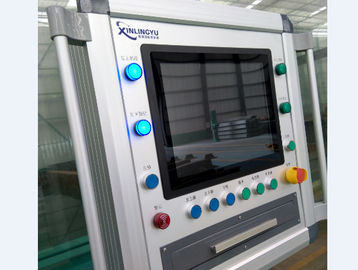
High-speed pulse firing under PLC control. Two 450 kW burners fire in short pulses, and dual K-type thermocouples read both the furnace zone and the liquid zinc. When the bath nears target, the controller automatically corrects the furnace set point and switches between heating and cooling modes to cancel thermal inertia.
| Parameter | Design Value |
|---|
| Zinc working temperature | 435–450 °C, tolerance ±2 °C |
| Furnace / flue temperature | ≤ 650 °C; wall ≤ 50 °C |
| Burners | 2 × 450 kW, 30 kg/hour fuel |
| Heat-up rate at full power | 60–200 °C/h, adjustable to a set curve |
Q3. What actually determines kettle life?
Thermal cycling, not tonnage. Overshoot above 450 °C accelerates wall erosion and thickens the dross layer, which insulates the wall and forces even more heat. Pulse control with ±2 °C tolerance keeps the dross thin. A steel support pan controls wall deformation, and a zinc leakage alarm with a dedicated collection pit turns a catastrophic failure into a manageable event.
Q4. Will the line pass an unannounced emission inspection?
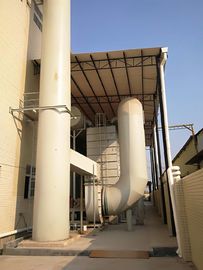
It is designed to. Acid fume is captured in a closed 61.0 × 3.8 × 6.5 m room and treated in two series PP washing towers: HCl in the tail gas stays below 100 mg/m³ with an emission rate under 0.43 kg/h through a 20 m chimney. The first water-spray tower recovers dilute hydrochloric acid for rack cleaning, which reacts with residual zinc to form zinc chloride usable in the flux — abatement that partially pays for itself. Zinc smoke is captured by a negative-pressure closed hood at over 95% efficiency, with solid particles in the exhaust below 90 mg/m³ and blackness at grade 1.
Q5. What utilities must I provide?
A maximum connected load of 230 kW, 0.01 m³ of water per ton of product at no less than 0.2 MPa supply pressure, and 3 m³/min of compressed air at 0.5 MPa. Neutralized process water is returned to production rather than discharged, so the water figure is mostly make-up.
Q6. How much floor space does the line need?
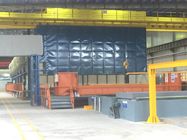
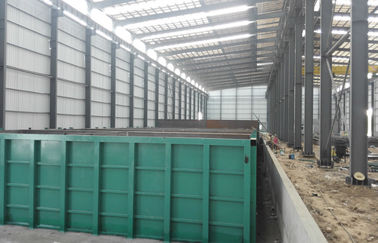
The reference line uses an 81 × 15.9 m workshop with a ring layout: a ring crane with six 2 t hoists at 10 m lift runs the whole cycle in series, with workpieces moving from degreasing through pickling, fluxing, galvanizing, quenching and passivation without reversing. Ring layout beats straight-line layouts on cycle time in almost every mid-size plant.
Q7. Can I cut fuel cost without changing fuel?
Yes — two recoveries do most of the work. Flue gas passes through a titanium-tube exchanger that holds the flux bath at 60–70 °C automatically, removing a separate heating circuit. Using exhaust gas to preheat incoming combustion air cuts fuel consumption by roughly 10%. On a 20,000 ton line the payback on that exchanger is measured in months.
Q8. What does delivery actually include?
Investment scheme and model selection, free equipment layout and factory planning, foundation drawings and on-site civil guidance, installation and commissioning, and operator training — one contract, one team, standard delivery in 90 days. Send your workshop drawing and target tonnage and the engineering team will return a customized proposal with layout, utility schedule and emission guarantees.


 आपका संदेश 20-3,000 अक्षरों के बीच होना चाहिए!